
When the Wind Shifts: Rates, Bonds and Your Plan

Remember a few years ago when everyone was grumbling that interest rates were too low. It was the early 2020s, and the government was trying to juice the post-pandemic economy. Savers were especially upset - $10,000 in the bank meant earning a paltry $10 per year in interest. That’s two Happy Meals…maybe. Home buyers were pleased that mortgage rates were low, but that was not much comfort because home sellers realized they could now list their homes for a lot more.
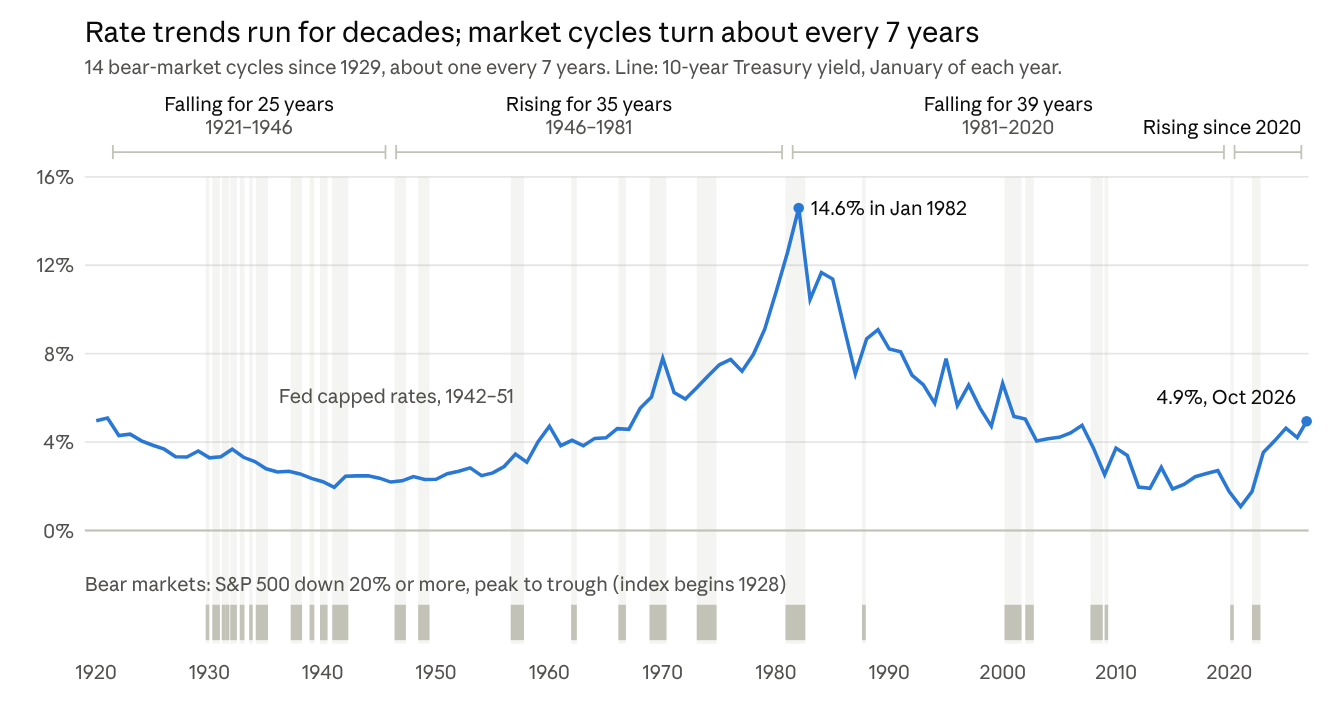
A lot has changed since then. Low interest rates, massive government stimulus, AI spending, and global conflict have led to persistent inflation. The last two administrations have vowed to tackle inflation, but perhaps it’s bigger than any political party. Years ago, I observed in another newsletter that interest rate cycles can last quite a long time. This chart illustrates the point.,
Does this mean that rates will stay high for another 25 years? We don’t know, but it’s still a good idea to plan for that possibility.
Which of these sounds like you?
1."I have cash sitting around."
Cash finally pays again. A money market fund earning close to 4% turns that $10 a year on $10,000 into something closer to $400. That's a lot more Happy Meals. Just remember those rates can drop as fast as they rose, and with inflation running near 3.7%, cash is mostly treading water before taxes. Money you won't need for several years probably belongs back in your long-term plan. How much to keep liquid is one of the conversations we have most often with clients.
2. "I want more safety, or retirement is close."
Bonds are back to their old job: steady income, and some ballast when the rest of your portfolio gets bumpy. When rates rise, bonds you already own lose value, which is why many statements show slight losses this year. But new money buys today's higher yields without taking that hit.
1.multpl.com, 10-year Treasury / long-term government bond yields by year (Shiller; U.S. Treasury). January values 1920–2026 plus October 30, 2026.
2. Hartford Funds, S&P 500 bear markets, 1929–2024, citing Ned Davis Research. Declines less than 18 months apart counted as one cycle.
3. U.S. Consumer Price Index, September 2026.
Safety costs less. With 10-year Treasuries paying close to 5%, you may still be able to get a good return without taking as much risk.
Bonds can lock in a rate. A money market rate can reset lower. A bond holds its yield for years. The highest-rated corporate bonds averaged over 6% in October, and credit quality is improving.
Munis are worth a look if you're in a high tax bracket. Their interest is generally free of federal income tax. Vanguard puts today's yields at the equivalent of close to 8% taxable.
The honest risk: if inflation and rates keep climbing, bonds could take longer to pay off. But with bonds about 5% below their peak and paying 5 to 6%, this may be a good entry point for long-term investors.
Bonds don't replace stocks or your emergency fund. How much you hold, and what kind, depends on your tax bracket, how soon you need the money, and how many ups and downs you can live with.
If you're within a few years of retirement, two more things to know. Higher rates mean each dollar of savings buys more guaranteed income, so this can be a good time to lock in a portion and let the rest stay invested for growth. And if your anticipated pension offers a lump sum, higher rates shrink it while the monthly check stays the same. Let's run the numbers together before you choose.
3. "I'm borrowing or buying."
Under 4% on your mortgage? Hang on to it. It's one of the best things in your financial life.
Borrowed more recently? Paying down a 7% mortgage or a variable-rate home equity line saves you that 7% with no market risk.
Credit card debt comes first, always.
Waiting for rates to fall before you buy? Maybe they will, maybe they won't. A better test is whether the house and the payment fit your plan today. If rates drop, you can look at refinancing. If not, you've already budgeted for the payment you have.
4. "I'm worried about rising prices."
Inflation raises the cost of everything your plan has to pay for, especially in retirement when income may be fixed. A few tools help keep your purchasing power intact:
Own things that get more expensive. Companies with pricing power can raise prices or rents without losing customers, because we all still buy necessities. Owning them through your portfolio is a lot easier than owning a forest or a rental building. Of course, stocks tend to be more volatile, so they belong in the long-term portion of your portfolio.
Inflation-protected bonds. TIPS adjust with the Consumer Price Index, and real yields are higher than they have been in years. I Bonds do the same for smaller amounts, up to $10,000 per person each year.
4. Vanguard, “How 2026 may set the table for stronger bond returns,” October 21, 2026. The 10-year Treasury yield reached 5.18% in late September 2026.
5. Moody’s Seasoned Aaa Corporate Bond Yield, October 2026 monthly average of 6.12% (bonds with maturities of 20 years and longer), via FRED, Federal Reserve Bank of St. Louis.
6. Dan Bruzzo, “Credit quality holds steady as borrowing surges,” SanCap Portfolio Strategy, October 30, 2026, citing S&P data: 255 upgrades and 43 downgrades year to date.
7. Vanguard, “Municipal bond yields at nearly their best in a decade,” October 22, 2026. Tax-equivalent yield assumes a 40.8% federal rate (37% top income tax rate plus the 3.8% net investment income tax).
8. Range reflects the 10-year U.S. Treasury yield of 5.18% in late September 2026 (Vanguard, “How 2026 may set the table for stronger bond returns,” October 21, 2026) and the October 2026 average Moody’s Seasoned Aaa Corporate Bond Yield of 6.12% (FRED, Federal Reserve Bank of St. Louis).
9.Freddie Mac Primary Mortgage Market Survey, October 22, 2026.
10. multpl.com, 30-year real (TIPS) yields by year.
11. U.S. Department of the Treasury, TreasuryDirect, “I bonds.” Electronic I bond purchases are limited to $10,000 per person each calendar year.
Lock in your interest rates using fixed-rate debt. Future dollars are less valuable than a dollar in your pocket today. One more reason to keep a low-rate loan if you don't mind staying put.
Income that adjusts. Social Security and some other pensions rise each year with a cost-of-living adjustment. Delaying your claim means those adjustments apply to a bigger check.
A longer view. Climate-related costs and a shrinking global workforce could keep prices rising for years. Longwave selects funds for certain portfolios that weigh these long-term risks.
The bottom line
Nobody controls interest rates. Not you, not me, and only partly the Fed, which sets short-term rates while the market sets long-term ones. What you do control is how your plan responds.
Rates will go up and down, as they always have. The people who come out ahead tend to plan ahead, stay invested, and adjust along the way.
Sources
12. Kotz, M., Kuik, F., Lis, E. & Nickel, C. (2024), “Global warming and heat extremes to enhance inflationary pressures,” Communications Earth & Environment 5, 116.
13. Goodhart, C. & Pradhan, M. (2020), The Great Demographic Reversal: Ageing Societies, Waning Inequality, and an Inflation Revival, Palgrave Macmillan.
14. Federal Reserve, FOMC statement, October 28, 2026.