
Back to School: The New Kids' Savings Account, Explained

Every so often, Washington adds a new account to the alphabet soup of American savings vehicles — the 401(k), the IRA, the 529 — and families are left to figure out whether the newest arrival deserves a place in their plan. This month brought exactly that moment. On July 4, 2026, one year to the day after they were created by law, Trump Accounts officially launched, and more than six million families signed up before the doors even opened.[i]
As with anything new out of Washington, the early coverage has run the gamut from breathless to dismissive. Our job, as always, is to distill the noise and focus on what you actually need to know. So we spent time with the law itself, the Treasury Department's rollout materials, and the early analysis from tax professionals — and what we found is a savings vehicle that is genuinely useful in some situations, clearly second-best in others, and, in one respect, quietly more interesting than the headlines suggest.
Here is our plain-English guide to how these accounts work, where they fit, and what they might mean for your children and grandchildren.
THE BASICS: A RETIREMENT ACCOUNT THAT STARTS AT BIRTH
Despite the novel name, a Trump Account is not an entirely new invention. Under the hood, it is a traditional IRA for children — created under new Section 530A of the tax code — that operates under special rules until adulthood.[ii] Any child who is a U.S. citizen under age 18 with a Social Security number is eligible, and accounts can be opened by a parent or guardian through the official app at trumpaccounts.gov, or by filing a new IRS Form 4547 (yes, that number is deliberate).[iii]
The defining feature is what the law calls the "growth period": from birth through the end of the year before the child turns 18, money can go in, investments compound, and — importantly — nothing can come out. There is no earned income requirement, which is a genuine first. Until now, a child needed wages from babysitting, lifeguarding, or a summer job to fund any kind of IRA. A Trump Account requires no paycheck at all. Once the growth period ends, the account becomes, for all practical purposes, an ordinary traditional IRA belonging to the now-adult child.
THE HEADLINE: A $1,000 HEAD START FOR NEWBORNS
The feature driving most of the sign-ups is the pilot program: the federal government will make a one-time $1,000 contribution to the account of every eligible child born between January 1, 2025 and December 31, 2028.[iii] This is not a match or a loan — it is simply seed money, and for families with a qualifying newborn, we see very little reason to leave it unclaimed.
Private dollars are beginning to stack on top of the public ones. Michael and Susan Dell have pledged $250 apiece into as many as 25 million children's accounts, and in early July the Treasury announced it will accept large philanthropic contributions of publicly traded stock to support the program, creating a pathway for further large-scale private giving.[i] It is worth noting that of the six-million-plus children enrolled so far, only about 1.4 million were born in the pilot window and qualify for the $1,000 — a reminder that many families see value in these accounts beyond the free deposit.[iv]
CONTRIBUTIONS AND INVESTMENTS: SIMPLE BY DESIGN
Who can contribute, and how much. Up to $5,000 per year (indexed for inflation) can go into a child's account, and the contributions can come from anyone — parents, grandparents, other relatives, family friends. Employers may also contribute up to $2,500 per year to an employee's child's account, and that benefit is excluded from the employee's taxable income, though it counts toward the same $5,000 cap.[iv] Contributions from individuals are made with after-tax dollars and are not deductible; they form "basis" in the account that is never taxed again. Government, employer, and philanthropic contributions, by contrast, go in pre-tax.[v]
How the money is invested. Congress deliberately kept the menu simple: during the growth period, funds must sit in low-cost index funds tracking primarily U.S. companies, with expense ratios below 0.10 percent. At launch, every account is invested in a single S&P 500 index ETF as the default, and the Treasury has announced four additional broad-market index funds that families will be able to elect once that functionality is switched on in the coming months.[vi] For long-term money, low-cost and broadly diversified U.S. equity exposure is a reasonable place to be — though we would note it offers no international diversification and no ability to dial risk down as a goal approaches.
THE TAX STORY: WHERE THESE ACCOUNTS GET INTERESTING
During the growth period, everything compounds tax-deferred — no annual taxes on dividends or gains, which is a real advantage over a regular brokerage or custodial account. The complication arrives on the way out. Because the account matures into a traditional IRA, earnings are eventually taxed as ordinary income, and withdrawals before age 59½ generally add a 10% penalty on the taxable portion. A young adult who simply cashes out at 18 could face a meaningfully worse tax outcome than if the same dollars had grown in a plain brokerage account at capital gains rates.
The Roth conversion opportunity. This is the piece that has tax professionals paying attention, and in our view it is the most compelling feature of the entire program. Once the account becomes a traditional IRA at 18, it becomes eligible for a Roth conversion — and tax attorneys are describing this as a legal on-ramp into a Roth IRA for children who never had earned income, something that simply did not exist before.[vii] The after-tax basis converts tax-free; only the pre-tax dollars (the federal seed, any employer or philanthropic money, and all the growth) are taxable at conversion. And if the conversion happens in a low-income year — say, during college or early career — the tax bill can be modest or even zero. For 2026, a non-dependent single filer's standard deduction is $16,100, meaning a young adult with little other income could convert up to that amount federally tax-free, and repeat the exercise over several years.[vii]
Two cautions keep this strategy from being automatic. First, the "kiddie tax" can apply to dependents and full-time students up to age 23, taxing unearned income above roughly $2,700 at the parents' rate — so the timing of conversions matters a great deal, and waiting until the child is clearly independent (or age 24) is the cleanest path.[iv] Second, the conversion tax should ideally be paid with money from outside the account; pulling it from the account itself triggers tax and penalty and shrinks the very balance you are trying to grow. The annual gift exclusion ($19,000 per person in 2026) gives parents and grandparents a simple way to cover that bill as a gift.
HOW THEY FIT: TRUMP ACCOUNTS NEXT TO THE TOOLS YOU ALREADY KNOW
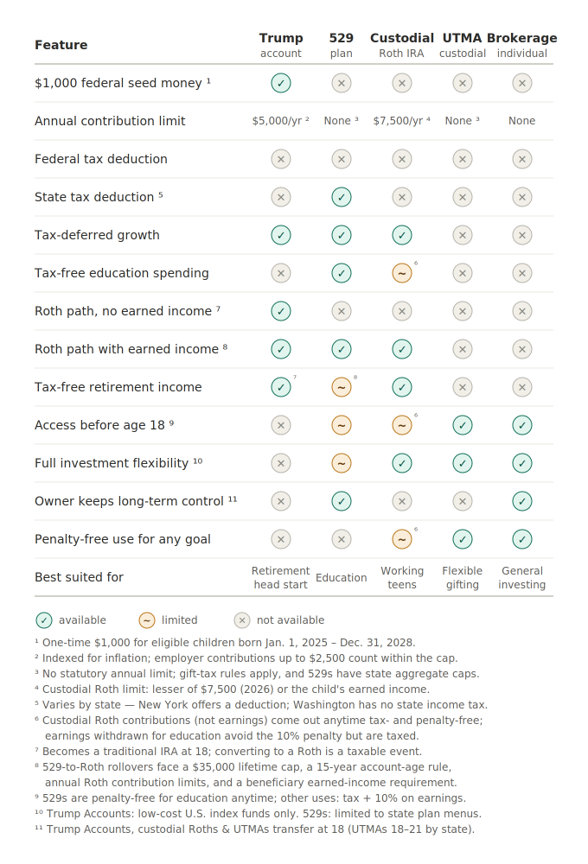
A new account does not change first principles — the goal determines the vehicle.
For education, the 529 plan still wins. Qualified withdrawals are entirely tax-free, many states (including New York) offer a state tax deduction for contributions, and unused funds now have their own limited path into a Roth IRA. If the money is earmarked for college, a Trump Account is generally the wrong pocket.[v]
For a working teenager, the custodial Roth IRA still wins. Once a child has real earned income, Roth contributions (up to $7,500 in 2026) go in after-tax and never face tax again — no conversion required.[iv]
For flexibility, custodial brokerage accounts (UTMAs) still have their place. They can hold anything and be tapped anytime for the child's benefit — a first car, a security deposit — which a Trump Account cannot.
The Trump Account's unique lane is the child with no earned income and a very long runway: free seed money for those born in the pilot window, tax-deferred compounding from birth, and the eventual Roth conversion path. It is less an either/or decision than a question of layering — and of matching each dollar to its job.
WHAT WE'RE WATCHING: OPEN QUESTIONS
This program is two weeks old, and some meaningful details are still being written. Investment elections beyond the default fund are not yet live. State tax treatment of these accounts remains unsettled in many states. How balances will be counted for college financial aid purposes is not yet clear. And any strategy that spans two decades carries an unavoidable caveat: tax law changes, and a Roth conversion window that exists today is not guaranteed to look identical in 2044. We will keep following the guidance as it develops and will update you when the picture sharpens.
THE BOTTOM LINE
If you have welcomed a child or grandchild since the start of 2025 — or will before the end of 2028 — claiming the $1,000 federal contribution is close to a no-brainer, and enrolling takes minutes. Beyond that, whether to add your own dollars depends on the goal: education points to a 529, a teenager's wages point to a Roth, and long-horizon retirement seeding for a child is where the Trump Account genuinely stands alone. As always, the right answer lives in the details of your family's plan, and conversions down the road should be coordinated with your tax professional.
If you are wondering how a Trump Account might fit alongside the accounts your family already has, let’s talk. We are happy to walk through it together.
Sources:
[i] U.S. Department of the Treasury, "Treasury and IRS to Accept Philanthropic Stock Contributions for Trump Accounts", 2026.
[ii] Congressional Research Service, "Trump Accounts: Overview and Policy Considerations," R48910.
[iii] Trump Accounts program information.
[iv] TheStreet, "Trump accounts hide Roth IRA strategy worth a fortune", 2026.
[v] Center for Retirement Research at Boston College, "Trump Accounts: A Primer for Parents".
[vi] U.S. Department of the Treasury, "Treasury Announces Investment Lineup for Trump Accounts", 2026.
[vii] CNBC, "Trump Accounts create a 'legal backdoor' for Roth IRA wealth, tax attorney says", 2026.
Author: Socrates Leotsakos, CFP®
Client Relationship Manager, Longwave Financial
Socrates Leotsakos, CFP®, is a Client Relationship Manager at Longwave Financial. He began his career as a Financial Planner at independent advisory firms in North Jersey, working with domestic and international high-net-worth clients ranging from families to celebrities to C-suite executives.
Socrates holds a B.A. in Economics from Cornell University, with concentrations in Business and Information Science. In 2024, he earned his CERTIFIED FINANCIAL PLANNER® certification, administered by the CFP Board, which requires rigorous education, examination, and ethics standards. He stays current on financial planning regulations and macroeconomic trends, applying a diagnostic approach to understanding each client's needs before recommending a course of action.
In his role at Longwave, Socrates focuses on building meaningful, lasting relationships that help clients achieve their financial goals.
*CFP® and CERTIFIED FINANCIAL PLANNER® are certification marks owned by the CFP Board of Standards, Inc.
This material is intended for informational/educational purposes only and should not be construed as investment, tax, or legal advice, a solicitation, or a recommendation to buy or sell any security or investment product. Longwave Financial LLC does not offer legal or tax advice; please consult a legal or tax professional regarding your individual situation. Investments are subject to risk, including the loss of principal, and past performance is no guarantee of future results. Program details referenced herein are based on law and guidance available as of July 2026 and are subject to change.