
Longwave Goes to Washington: We’re Not Just Watching the Markets—We’re Joining the Conversation on Your Behalf
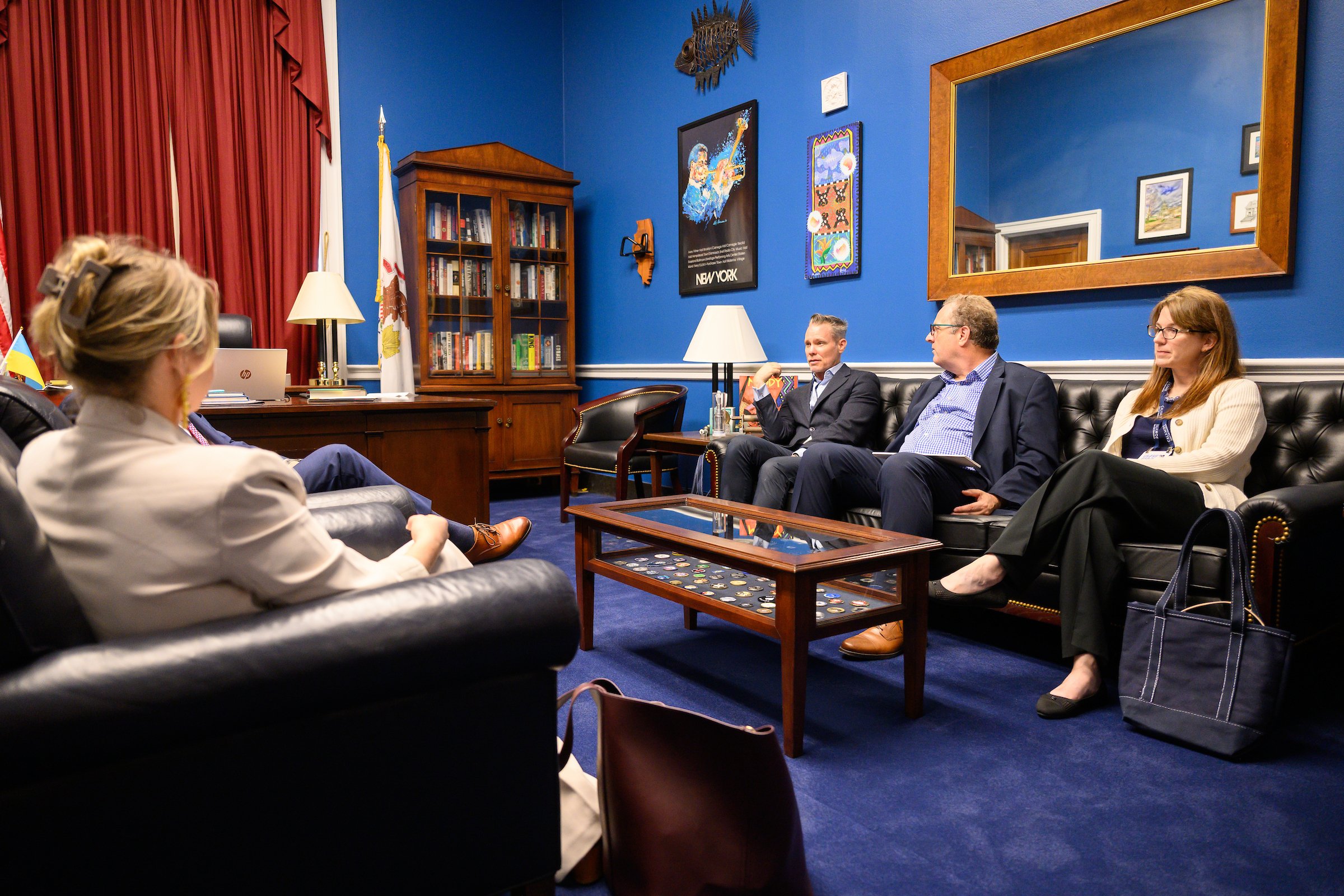
Not everything that shapes your financial future shows up on your account statement. Some of it is decided in Washington—and right now, sustainable investing is under more political pressure than at any point in its history. Decisions being made there will shape what you are allowed to know, own, and say as an investor. So for the second year, I traveled to Washington, D.C., for US/SIF’s annual Capitol Hill Day to bring investors’ needs directly into those conversations.
We met with Representative Sean Casten (D-IL) and Representative Ritchie Torres (D-NY), both members of the House Financial Services Committee, and with staff for Senator Tim Scott (R-SC) and Senator Jack Reed (D-RI), the chair and the most senior Democrat on the Senate Banking Committee. These are the committees that write the rules on capital markets, disclosures, shareholder rights, and investor protections. Representative Casten, who founded the Congressional Sustainable Investment Caucus to help lawmakers understand sustainable investing, was an especially important meeting.
Here is what’s on the table: Roughly two-thirds of states have passed laws restricting whether public funds or state contractors can consider environmental and social factors. Some of this is energy politics: states whose economies depend on oil and gas have moved to punish financial firms they accuse of “boycotting” fossil fuels. Some of it is a real debate about what retirement fiduciaries owe the people they serve. And some of it, frankly, is the culture war finding its way into your portfolio. Whatever the motive, the effect is the same: politicians deciding what investors are allowed to know and consider.
These policies come with real costs. When Texas barred municipalities from working with banks that had ESG policies, five of the nation’s largest bond underwriters left the state, and researchers at the Wharton School and the Federal Reserve Bank of Chicago estimated Texas cities paid an extra $300–500 million in interest in just the first eight months (Garrett & Ivanov, 2022). Indiana’s own legislative analysts projected that forcing the state pension system to drop ESG-minded managers would cost retirees $6.7 billion over ten years. Higher borrowing costs become someone’s taxes; lower pension returns come out of someone’s retirement check.
But you do not need to live in Texas or Indiana to feel this. If you have a 401(k), the pressure reaches your menu: a federal court recently ruled that American Airlines breached its duty to workers simply by letting its index manager cast ESG-minded proxy votes—and employers, wary of the next lawsuit, are quietly keeping sustainable options off retirement plans altogether. The rules on whether your retirement plan may even consider these factors have flipped with each of the last three administrations, and Congress is weighing legislation to restrict them again. If you own funds, it reaches your choices: managers have closed, renamed, or softened sustainable funds to avoid political blowback, shrinking the shelf available to you. And if you own shares, it reaches your voice: new restrictions on proxy advisors and shareholder engagement make it harder for your votes to be heard. There is pushback—this February a federal court struck down Texas’s law as unconstitutional, finding the state had blacklisted firms arbitrarily—but the direction of pressure is clear.
That is why our message on Capitol Hill was simple: everyone should have the information, freedom, and tools needed to invest thoughtfully. As Longwave’s Director of Sustainability, I represented our clients in these conversations. We advocated for continued access to financially material information, so investors can weigh a company’s risks and opportunities and decide for themselves what belongs in their portfolios. We spoke up for shareholder rights, so investors and the investment managers working on their behalf can engage with companies and exercise their voices as owners. And we made the case for independent proxy-advisor research and for Community Development Financial Institutions, which direct capital toward businesses, housing, and economic development in underserved communities. The reception was encouraging: representatives and staff across political parties asked thoughtful questions and genuinely wanted to understand how these issues affect investors.
This experience reflects something important about our work: we do more than research and select investment managers, build portfolios, and monitor performance. We participate in the broader conversations shaping the investment landscape. We meet with our fund partners, whose stewardship teams engage directly with the companies they hold. We educate our clients and coordinate across their financial lives. Our goal is to help you understand what you own, recognize the risks and opportunities before you, and know that your interests are represented—from the institutions managing your capital to the halls of Congress where the rules affecting investors are written.
Sources
Garrett, D., & Ivanov, I. (2022). “Gas, Guns, and Governments: Financial Costs of Anti-ESG Policies.” Federal Reserve Bank of Chicago Working Paper 2023-07.
Indiana Legislative Services Agency, Office of Fiscal and Management Analysis. Fiscal Impact Statement, House Bill 1008 (2023).
American Sustainable Business Council v. Hegar, No. 1:24-cv-01010 (W.D. Tex., Feb. 3, 2026).
US SIF: The Sustainable Investment Forum, Capitol Hill Day 2026.
Author: Lane Spigner, CFP®, CSRIC®
Client Relationship Manager | Director of Sustainability, Longwave Financial
Lane Spigner, CFP®, CSRIC®, is Client Relationship Manager and Director of Sustainability at Longwave Financial, with over 15 years of experience in financial planning. As a Certified Financial Planner®, Lane spent much of his career supporting LGBTQ and progressive families in the New York City area, helping them build financial clarity and pursue long-term goals.
As a Chartered SRI Counselor (CSRIC®), Lane works with Longwave's advisory team to help clients align their investment decisions with their personal values, focusing on sustainable and impact investing. His approach centers on the belief that financial clarity creates the foundation for transformative change in clients' lives.
Lane holds a background from the South Carolina Governor's School for the Arts, Lander University, and NYU, bringing a creative, people-first perspective to financial planning.